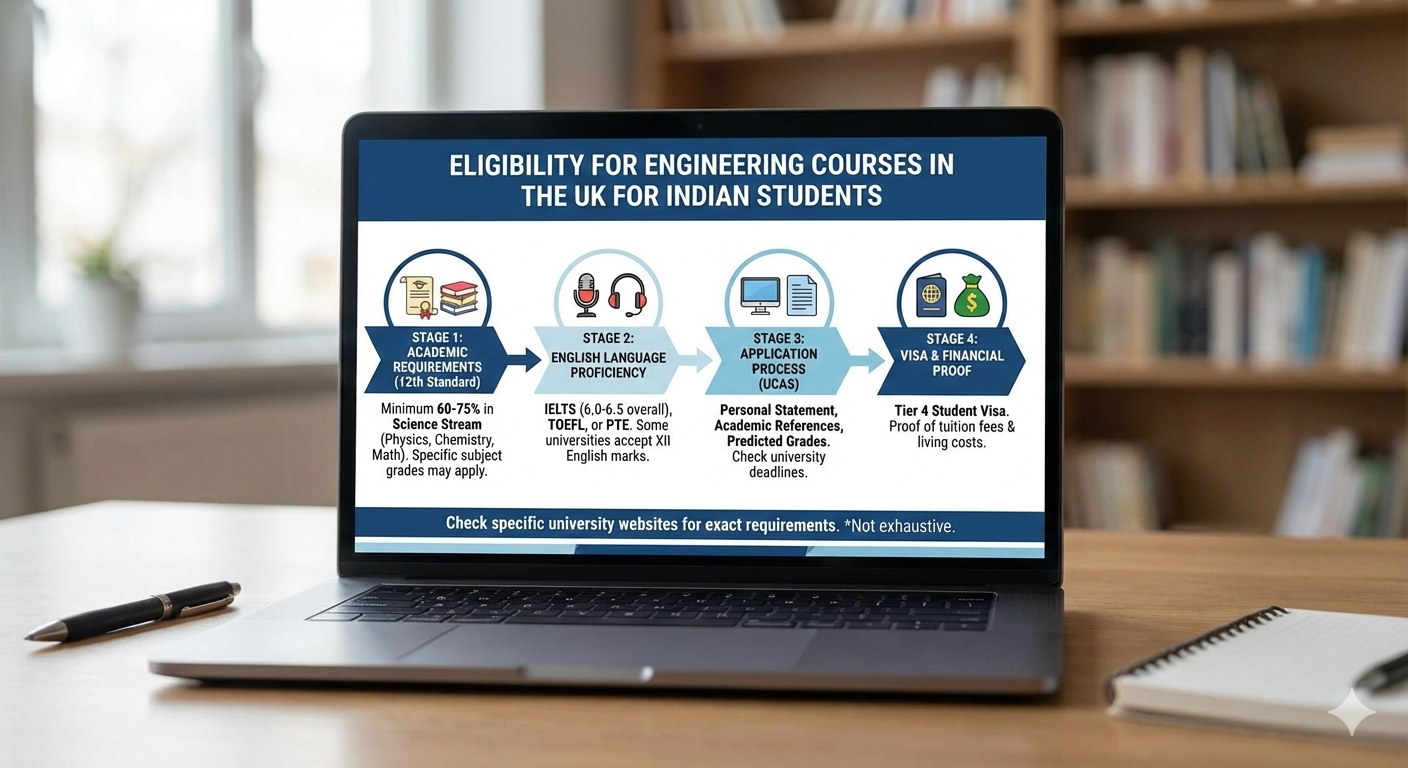
What Is the Eligibility for Engineering Courses in the UK for Indian Students?
Hey, if you’re an Indian student right now thinking about study Engineering Courses in UK, whether it’s a bachelor’s (BEng or MEng), a master’s (MSc), or even a foundation year to bridge the gap, the first thing you need to know is the entry requirements. UK engineering programs are some of the strongest in the world, with excellent industry links, placement opportunities, and global recognition, but the eligibility is clear, consistent, and very achievable for most Indian students. The rules vary a bit depending on whether you’re going for undergraduate or postgraduate, and whether you’re aiming for a top Russell Group university or a more teaching-focused one.
Here’s a straightforward, realistic breakdown of what Indian students actually need to meet for engineering courses in the UK in 2026/27.
Undergraduate Engineering (BEng / MEng)
For a 3-year BEng or 4-year integrated MEng:
- 12th Standard (CBSE/ICSE/State Board) — Most universities ask for 70–85% overall in PCM (Physics, Chemistry, Maths). Top universities (Imperial, UCL, Manchester, Bristol, Southampton, Sheffield) usually want 80–90%+ in PCM, with 85%+ specifically in Maths and Physics.
- English language — IELTS 6.5 overall (no band below 6.0) is the standard; some accept 6.0 overall. PTE 58–65 or Duolingo 105–120 are also widely accepted.
- Additional tests — Some top universities require the Engineering and Science Admissions Test (ESAT) or similar aptitude tests. Always check the specific course page.
- Foundation year option — If your 12th percentage is 60–70% or you don’t quite meet direct entry, many universities offer a 1-year International Foundation Year in Engineering. This leads straight into Year 1 of BEng/MEng and is very common for Indian students.
Postgraduate Engineering (MSc / MEng Conversion)
For a 1-year taught MSc in engineering branches (mechanical, civil, electrical, computer, aerospace, chemical, etc.):
- Bachelor’s degree — Usually a 2:1 equivalent (around 60%+ overall in India). Top universities want 65–70%+; mid-tier ones accept 55–60% if you have relevant projects or work experience.
- Relevant background — Most programs expect a bachelor’s in engineering or a closely related field (physics, maths, computer science). Some are conversion-friendly if you have strong motivation and related modules.
- English language — IELTS 6.5 overall (no band below 6.0) is standard; many accept 6.0 overall or PTE 58–65. Duolingo is accepted at some places.
- Work experience — The majority of taught MSc programs do not require work experience as a requirement yet your application will receive significant improvement through at least 1-2 years of engineering work experience in your field when applying to competitive universities.
- Personal statement —Your personal statement must include your motivation and career objectives together with your projects and experiences for all programs. Some design-related engineering programs which include aerospace and product design will require applicants to submit a portfolio.
Other Common Requirements for Indian Students
- APS Certificate — Not required for the UK (unlike Germany), but your degree and transcripts must be genuine.
- Visa funds — You’ll need to show proof of tuition + living costs (£1,334/month outside London, £1,023/month in London) for the visa.
- Scholarships — Many universities offer £1,000–£10,000 merit awards for engineering students. Apply early—often automatic or tied to January–May deadlines.
Final Thoughts for Indian Students
Eligibility for engineering courses in the UK is very achievable for Indian students. Mid-tier universities accept 60–70% in 12th or bachelor’s with IELTS 6.5, while top ones want 80%+ and stronger profiles. The key is matching your grades, English level, and any experience to realistic universities rather than chasing prestige alone.
Start by checking the official international websites of universities that interest you. You should examine the BEng/MEng or MSc engineering course pages to find current entry requirements and fees and September 2026 availability because they update their information on a regular basis.
Indian students who need assistance with program selection and application preparation and visa planning should contact study in UK consultants. We can review your current qualification, English level, budget, and career goals to see what fits best. Things move fast, always verify directly on university sites and UKVI. What’s your engineering branch (mechanical, computer, civil, etc.), 12th/bachelor’s percentage, or preferred city? I can give you more specific suggestions right now.

At Techratan, we bring you the latest updates from the world of technology and startups—covering breaking news, trends, funding updates, and industry insights. Our mission is to empower readers with accurate, timely, and engaging content that helps them stay ahead in the ever-changing tech landscape. Whether you’re an entrepreneur, investor, or tech enthusiast, Techrata is your trusted source for innovation-driven news.